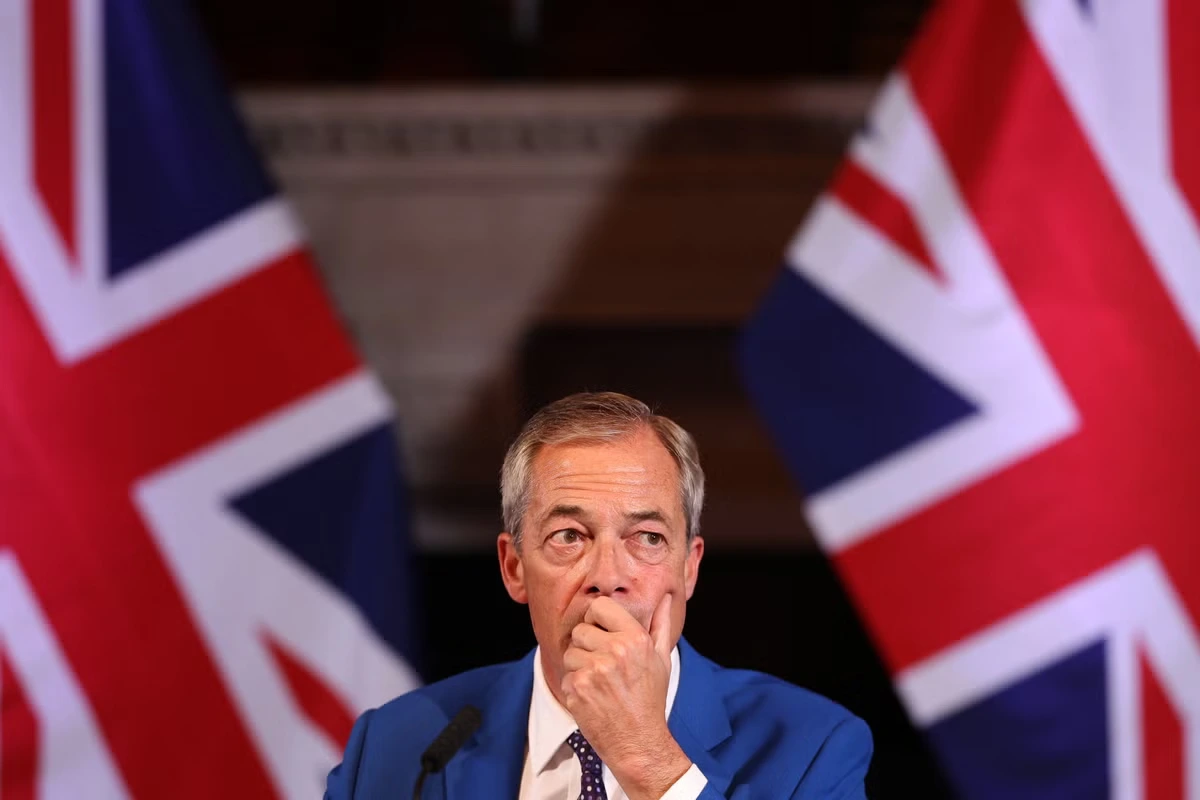
“Well that’s for you to judge,” cracked Nigel Farage when asked if he will be prime minister back in May.
Amongst the celebrations, Mr Farage was clearly lapping up Reform UK’s success in the local elections, winning 1,454 councillor seats and taking control of 14 councils, while the party opened up a seven-point lead ahead of a languishing Labour party in the polls.
Using a racing metaphor, he said in another interview: “This [local election] for me was our Becher’s Brook.... if we cleared Becher’s Brook and landed well, we go on to win the Grand National. What is very clear to me is that our voters will stick with us now all the way through.”
With the party’s pre-election slogan “vote Reform, vote Starmer out”, Reform HQ got what they desired, but without the wanted general election when Sir Keir eventually threw in towel.
However, a subsequent rise in popularity for Labour under new prime minister Andy Burnham coupled with a resurgence in Tory support has thwarted Mr Farage, despite the securing of a record-breaking £72m in donations from crypto entrepreneurs in September.
The latest Ipsos polling showing Reform seven points behind Labour appears to confirm a collapse in the party’s support. Mr Farage’s joke at the May elections over a “Kemi bounce” has not aged well.
Now, six months on from the party’s local election conquest, cracks have opened at a local level.
September and October, in particular, saw a flurry of Reform councillor resignations, suspensions and defections – some in the wake of the ITV Exposure documentary, which revealed party members making racist and sexually explicit comments.
According to Open Council Data UK, Reform has lost 41 councillors since June 1, down 1.8 per cent from 2,342 to 2,301. That is more than any other major party. Labour lost 35, but from a starting point of 4,616 councillors in June, down 0.8 per cent. The Lib Dems lost five councillors, 0.1 per cent down from 3,360 in June, while the Tories slightly increased its seats by 13 from 3,849 in June.
The figures start from June to exclude councillors who stepped down to become members of the Senedd following the Welsh Parliament elections in May.
Reform had been tasting success, having performed well in both last year’s and May’s local elections, along with a rise in numbers during the period in between, but it’s the recent fall in numbers that could raise concern.
The party has told The Independent its own analysis showed it has lost fewer councillors than both Labour and the Tories since May last year, both in numbers and percentage of councillor counts. But recent defections and resignations are apparent, and even threaten the party’s majority on some councils.
In Durham, which was focus of a Sky News investigation into “chaos” at the council in September, three councillors – Lyndsey Fox, Paul Sexton and Nicole Brown – all left the party to become independent councillors. Then last month, Reform councillor Aaron Hillam resigned after moving away from the area. It took the number of Reform councillors down from more than 60 in May 2025, to 50 out of 98 seats, with the party’s majority hanging by a wire.
Councillor Fox told Sky News she had stepped down over the party’s alleged failure to respond to a “serious safeguarding issue” she had raised in July. “I am left with no confidence that safeguarding is being treated as a priority within Reform,” she said in a statement. Reform’s council leader, Andrew Husband, responded by saying councillors Fox, Sexton and Brown had “let their residents down”.
In Worcestershire, the minority Reform administration on the county council has faced huge challenges with the authority’s finances. In February, it drew criticism after putting up council tax by almost 9 per cent to save, it said, the authority from “financial collapse”. One Reform councillor quit over the move.
But for councillor Karl Perks, who defected from Reform to the Conservatives in July, it was the council’s failure to consider prosecutions for those painting roundabouts with the cross of St George that proved the tipping point for him.
Councillor Perks, who had previously been the cabinet member for highways until March, said: "Too often, I saw division encouraged where unity was needed, and fear and anger amplified where compassion and restraint were called for.” Reform won 27 seats on the council in May last year, but now has 21 – still eight more than the Conservatives, which are the second biggest party in the authority.
In several cases, councillors have left in controversial circumstances.
Alan Feeney resigned as Reform councillor on Solihull and Birmingham councils after an undercover sting by ITV revealed him making racist comments about Asian homeowners. Mr Feeney later apologised and called the language “wrong and “completely unacceptable”.
Reform suspended George Madgwick, a councillor on Hampshire County Council, with immediate effect after he was recently charged with 35 offences, including 12 counts of rape.
Many others defected over personal and political reasons, with the highest number becoming independent councillors. For those leaving for another political party, Restore Britain received the highest, with five defections.
In Lancashire, councillor Leon Graham defected from Reform to the Conservative party in July. He told The Independent he left over a lack of democracy within the party, which he said disliked internal and external scrutiny.
“The culture is toxic which comes from the very top and treacles down,” he said.
“Reform focus more on performative politics, creating headline grabbers such as playing the national anthem but only the first verse, or which flags can be flown. If you view their policies, they follow an ideological approach which disregards the consequences as opposed to a pragmatic approach which helps people.”
In Birmingham, councillor Rebecca Waters told The Independent she left the party after the Reform Birmingham group wrote to the Lord Mayor, a Muslim, calling for the English language to be only used in council meetings in England. The letter was written following a decision to invite an imam to share a Quranic verse in Arabic before his installation ceremony.
Ms Waters said: “Reform does not understand the work the Lord Mayor undertakes and how important his role is for Birmingham. Our city deserves respect for its civic institutions. Whatever party we represent, we should respect the office of Lord Mayor and the family who support them in that service.”
In Newcastle-under-Lyme, Reform councillor Christine Duffy resigned as councillor in August after claiming she had received “very little or no training for this role”. Embarrassingly, she initially sent her resignation to the wrong council.
And in Gloucestershire, councillor Michael Rees left Reform to join Restore Britain after claiming the direction of Mr Farage’s party “didn’t sit right with me”. Reform responded by saying he had betrayed voters.
A Reform spokesperson said: “Since the 2025 local elections, the Conservatives and Labour have lost more councillors than Reform, both in absolute numbers and proportionally.
“We look forward to The Independent applying the same scrutiny to those two parties, rather than cherry-picking short-term figures to suit its own blatant editorial bias.”