Russians once packed their swimming trunks and sunscreen for summer holidays in Crimea, or hiking boots for trips in the colder months to the picturesque Black Sea peninsula annexed by Vladimir Putin in 2014.
Now, travellers swap advice on first-aid kits and how to avoid drones as they drive through a war zone to the peninsula.
For millions of Russians who until recently could reach Crimea with ease, the new reality comes after Ukraine destroyed the road section of the Crimean Bridge, opened by Putin in 2018 as a symbol of Moscow’s grip on the peninsula.
Russian officials have yet to provide a timetable for restoring road traffic across the bridge, which was repeatedly struck by Ukrainian drones and rockets.
Tellingly, Russia’s transport ministry has removed one of the two arches from its official image of the Crimean Bridge, leaving only the railway crossing.
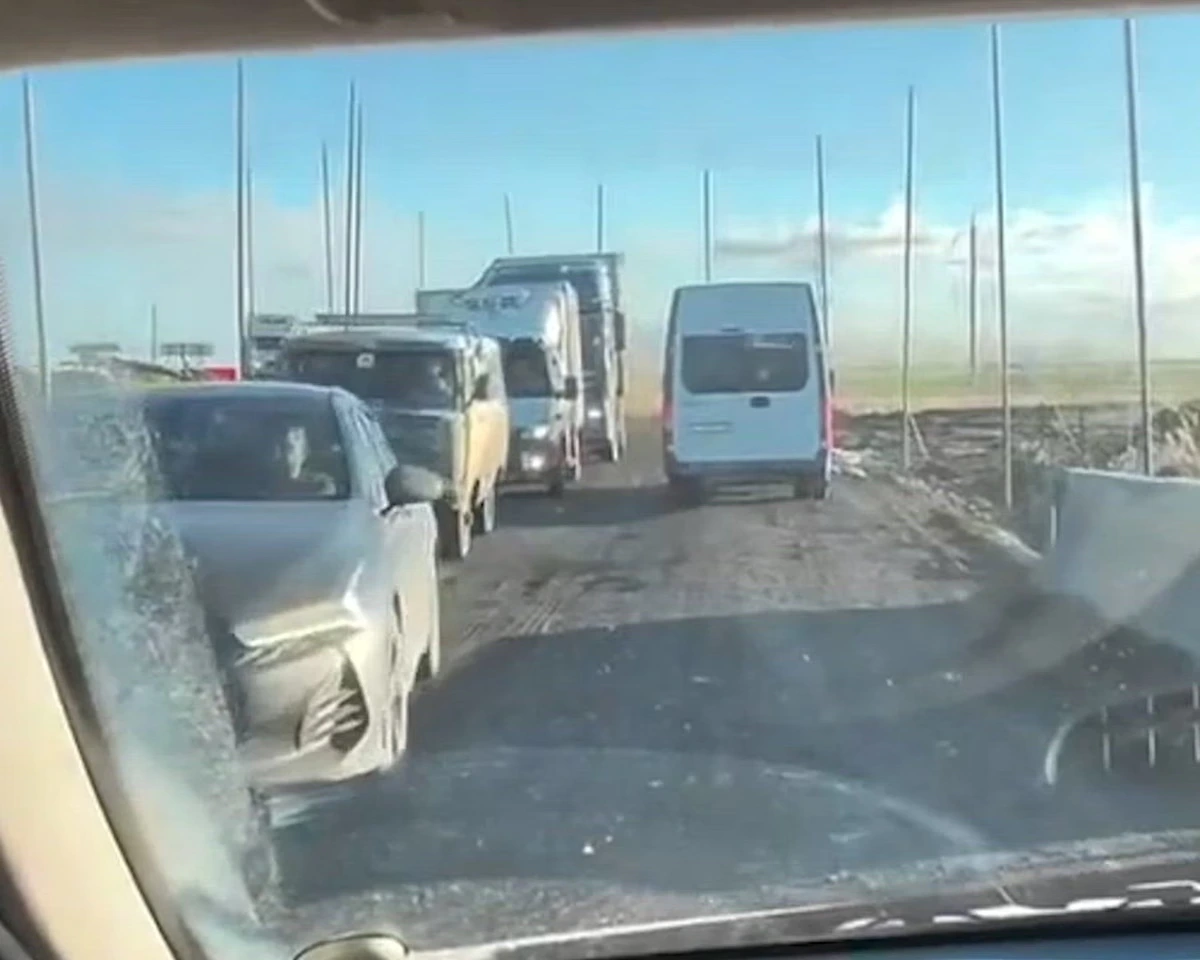
This leaves Crimea-bound motorists facing the prospect of months, if not years, of hazardous journeys along a road through occupied southern Ukraine littered with burnt-out trucks.
Before the full-scale invasion, the Crimean Bridge was the sole link between mainland Russia and illegally annexed Crimea, carrying tourists, food and fuel, as well as troops and military equipment.
But Russia’s occupation of parts of southern Ukraine in 2022 opened up a new land corridor to Crimea, along a highway that Moscow calls the Novorossiya route.
The roughly 390-mile (630km) road runs from Rostov-on-Don in southern Russia through the devastated city of Mariupol, along the Sea of Azov coast through Berdiansk and Melitopol, before entering Crimea.
The highway had already become a vital supply route for Russian forces in southern Ukraine, allowing Moscow to reduce its reliance on the Crimean Bridge for military logistics.
But that has also made the road an increasingly frequent target for Ukrainian attacks.
“What we saw was pretty apocalyptic,” said Anatoly, who had travelled to Crimea from mainland Russia to visit his parents.
“Trucks on fire and drones overhead that our boys were trying to shoot down. It was quite an adrenaline rush, but I wouldn’t recommend making the journey,” he added, asking for his surname to be withheld.
About 5 million Russians visit Crimea each year, according to the peninsula’s tourism authorities, although they have yet to publish figures for this year. The bridge was also the main road link for Crimean residents travelling to mainland Russia for cheaper groceries and petrol.
Passenger trains continue to cross the Crimean Bridge, though Kyiv has vowed to strike it again. A ferry service also operates across the Kerch strait, but carries passengers rather than cars and is frequently disrupted by winter storms.
With no easy alternative, drivers have begun compiling their own rules for surviving the journey.
A guide posted in one popular Telegram group, titled “How to drive the land route fast and alive”, opens with a stark warning: “Unless it’s a matter of life and death, don’t go.”
Drivers are urged to avoid travelling at night, because when “you’re alone on the road, the air defence teams can’t see you and you can’t see the drone”.
They are told to keep between 50 and 100 metres apart, stop only in designated areas and never shelter behind a lorry.
“A truck isn’t cover, it’s a target. A fuel tanker especially.”
Drivers are also advised to carry spare fuel – as much as 240 litres – along with two fire extinguishers, tourniquets and haemostatic dressings to stop severe bleeding.
They are further instructed to tune into local FM radio stations, whose broadcasts are interrupted by warnings when drones are spotted. Mobile air defence teams hang flags along the roadside, with white signalling the all-clear, red an alert and yellow a drone threat.
Even Russian state television has acknowledged the danger. On Sunday’s edition of the flagship Vesti news programme, a presenter said the road “passes through three frontline regions and comes under attack”.
Drivers were advised to stock up on food and water, and take a first-aid kit “and know how to use what’s in it”.
According to the programme, up to 20,000 vehicles a day travel along the highway.
Beyond threatening Crimea’s summer tourist season and the businesses that depend on it, the bridge’s destruction risks deepening hardship on the peninsula.
Ukraine’s air campaign to isolate Crimea has already caused fuel shortages and disrupted water and electricity supplies, prompting local authorities to declare several states of emergency over the summer.
Kyiv says its strikes are aimed at Russian military logistics rather than civilian vehicles, and the drivers’ guides acknowledge that ordinary cars are rarely hit.
However, the highway’s heavy use by Russian forces and lorries transporting fuel and other supplies to Crimea makes it a key target for Ukrainian strikes and puts civilian motorists at risk of getting caught up in the attacks.
Ukraine carried out an average of two strikes a day along the highway corridor in the first six months of 2026, according to the Armed Conflict Location and Event Data Project (ACLED), an independent conflict-monitoring organisation. About 90% of the strikes involved drones.
Some truck drivers have shared accounts of narrowly avoiding drones lying on the road and say they now wear bulletproof vests.
“Guys, watch out. When it gets dark, drive straight into the bushes,” one driver warned in a message shared online on Sunday.
“Yesterday my car ran over a lurking drone on the road. It was already dark, and the thing was just waiting there on the highway.”
Dmitry, a truck driver from Rostov who often crosses to Crimea, said he had recently considered quitting his job because of the risks, but was struggling to find other work and still had a mortgage to pay.
“For my birthday last month, I was given a tactical first-aid kit last month. I toasted that I would never have to use it.”