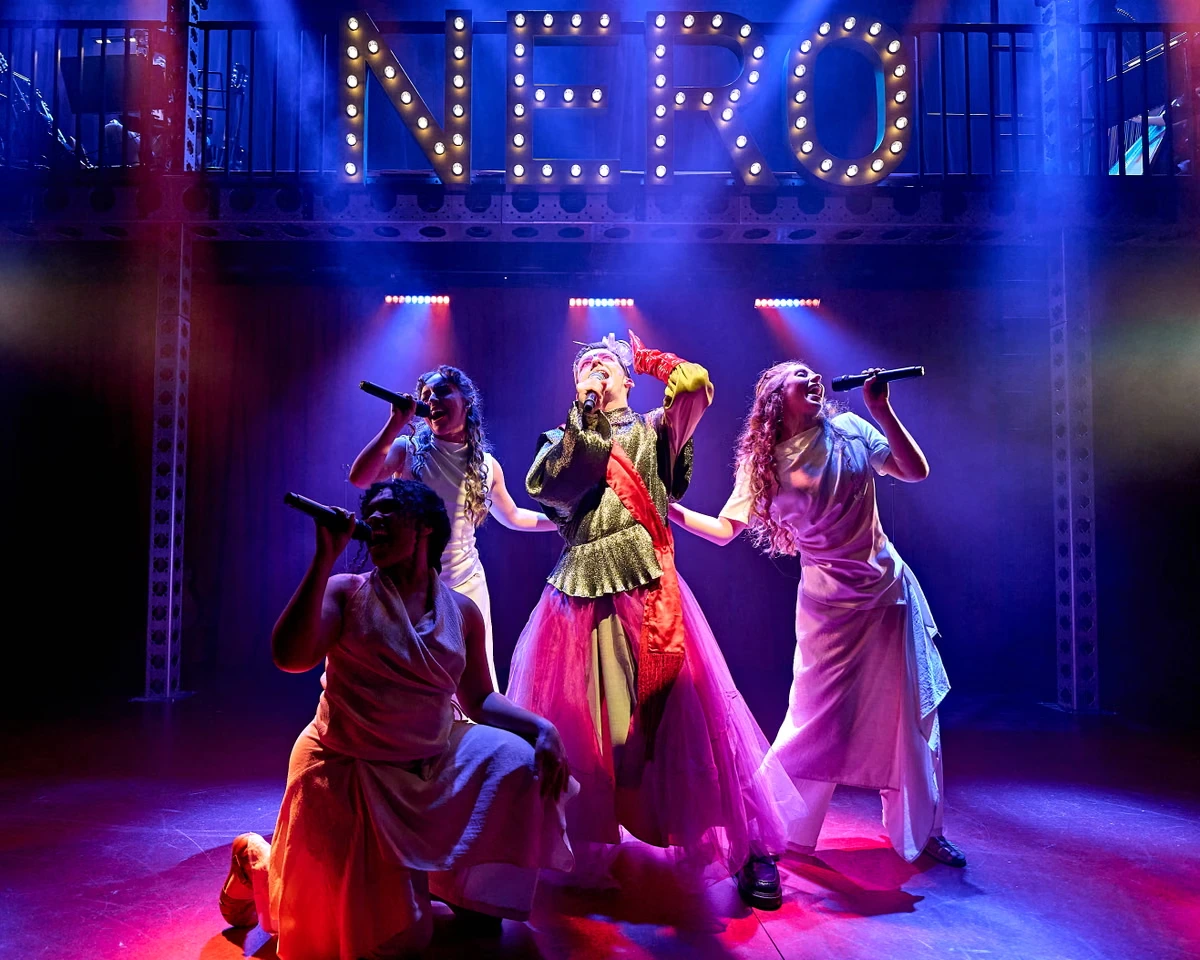
Before Spring Awakening won eight Tony awards in 2007, its dramatist and lyricist Steven Sater had “been struggling financially and professionally for quite a while,” he remembers. “Everyone said at the time: this is where it all starts!”
Sater and composer Duncan Sheik thought their next success would be Nero, about the Roman emperor who murdered his mother among many others, which had been produced in San Francisco in 2006. But only now, after two decades of workshops and showcases for potential backers, is Nero receiving its second full professional production. “I think maybe my work is too expensive for subsidised theatre and too risky for commercial theatre,” Sater says. “I don’t think that – audiences respond to my work – but I suspect producers may believe it.”
Spring Awakening had turned unlikely source material – Franz Wedekind’s 1891 German expressionist drama about adolescent sexual experimentation and suicide – into a Broadway hit that ran for two years. But producers still balked at whether Nero could be sympathetic or relatable. Sater is convinced that this objection has been addressed by the casting in the London production of Andrew Barth Feldman, star of Broadway’s Dear Evan Hansen: “He’s charismatic and endearing. We wrote Nero as a showman, like Richard III.”
Sater’s pleasure at Nero’s return has been cruelly diluted by Sheik’s recent death aged 56. The day before we talk, Sater Zoomed into the first read-through for the current New York revival of Spring Awakening. “That was emotional. I did break down. Thinking of Duncan and me with those young people in the first production 20 years ago.”
From London, Sater also watched an online tribute to Sheik at the Dramatists Guild Foundation Gala, a performance of Touch Me from Spring Awakening which, though describing sexual stimulation, is also a sort of lament: “It was his favourite song. Duncan saw sadness in a way that nobody else did. He had a real sense of tragic destiny. And the irony is that he had one.”
The duo “never worked in the same room”, he says. “It was like we shared a twin solitude. I wrote the lyric and then he wrote the music, setting exactly what I’d written. When we got notes from a director, I’d have to cajole Duncan into rewriting. Often we’d replace the whole song rather than change it.”
On Alice by Heart, their 2012 version of Alice in Wonderland set in London during the Blitz, Sater would “sometimes, if Duncan wasn’t available, take a song cut from Spring Awakening and write a new lyric”.
Improbably, this is one of two London autumn shows based on the work of the Roman historian Suetonius. In Caryl Churchill’s Triumph, a press secretary briefs reporters about a Trumpian emperor. Sater accepts that the belated staging of Nero reflects a perceived overlap between contemporary America and the final lurid decline of imperial Rome, although he made the connection much earlier than most observers. In 2003, President George W Bush landed in a fighter jet on the aircraft carrier USS Abraham Lincoln and declared the Iraq war won with the words: Mission Accomplished. “I rang Duncan and said ‘Rome is burning!’, and suggested doing a show about Nero.” Twenty-three years later: “When the president of the United States is razing [part of] the White House to build himself a golden ballroom, we are finally ready for a musical about Nero.”It will be, he says, “frighteningly of the moment”.
Apart from drawing on Suetonius for Nero and Wedekind for Spring Awakening, Sater also wrote a musical based on Aeschylus’s Prometheus Unbound, is working with James Bourne of Busted on a show inspired by Schnitzler’s La Ronde and, in his memoir A Purple Summer, attributes one Spring Awakening lyric to “my misremembering of Racine’s Phèdre”.
Becoming such an unusually literary lyricist was literally accidental: aged 20, Sater suffered multiple fractures and burns after jumping from a third floor balcony to escape a fire. “I was strapped to a board that turned me from back to front every two hours. I had page-turners made that I could operate with my teeth. And, that way, I taught myself Ancient Greek. And then I went to graduate school to study literature. I turn down so many things. Do I want to do a musical of Dances With Wolves or Jurassic Park? No, I don’t. If it takes at least eight years to get a musical on, I have to live with the source material for all that time. I could live my whole life in Suetonius or the Oresteia. I’m a classicist!”
As illustration, he waves the book he is reading in rehearsal breaks: a Greek edition of Aeschylus’s Oresteia. Surely that isn’t his next musical? “A play. A dramatisation of the assassination of President John F Kennedy, based verse by verse on Agamemnon by Aeschylus. Jackie Kennedy has the Cassandra speech in which she sees the future.”
Clearing out his mother’s house after her death, he found Life magazine covers about the death of JFK, a story he had dramatised as a student and now felt compelled to return to. “I’m afraid we’re looking at the death of American democracy. And so it is related to Nero in that way. It again felt so of this moment.”
-
At Southwark Playhouse Elephant, London, until 5 December