Strong winds are threatening to disrupt Thursday's Thanksgiving parade in New York City for the first time since World War Two.
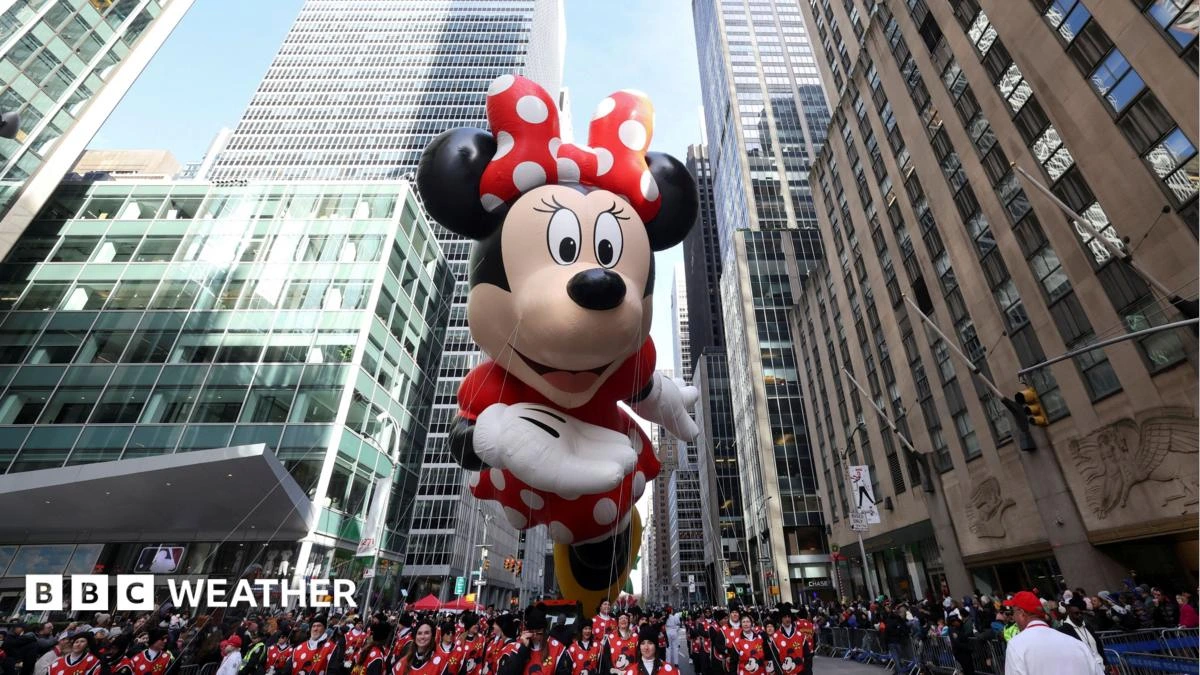
A potent Nor'easter storm could impact the Macy's Thanksgiving Day Parade which is due to be taking place for the 100th time, with the risk that it could be too windy for the event's iconic balloons to fly.
The US National Weather Service has issued a high wind warning, valid from 10:00 local time (15:00 GMT) on Thursday until 01:00 (06:00 GMT) on Friday with gusts potentially reaching 60mph (97km/h) - although the very strongest winds are likely to occur after the parade is due to end.
Heavy rain and coastal flooding will pose additional hazards across the eastern USA as the storm sweeps through, while some inland parts could also see snow.
Western areas of the country have also faced Thanksgiving travel headaches, with Pacific storms and coastal flooding.
Storms targeting both US coasts threaten to snarl Thanksgiving travel for millions
What is the Macy's Thanksgiving Day Parade?
The parade started life as the Macy's Christmas Parade, organised by employees at Macy's department store in New York City in a bid to boost holiday sales.
The first event took place on Thanksgiving Day 1924. It has only been cancelled during the World War Two, when it was put on hiatus between 1942 and 1944. As a result, this year marks the 100th parade.
It is due to take place from 08:30 local time (13:30 GMT), ending at around 12:00 (17:00 GMT) , and involves marching bands, street performers and floats parading through the streets of New York City, as well as 100 brightly-coloured inflatable balloons.
However, due to city regulations full-size balloons cannot fly if sustained winds exceed 23mph (37km/h), or in gusts of more than 35mph (56km/h).
There is a risk that Thursday will bring winds approaching those strengths.
However, record wind gusts also made the 1997 route a no-fly zone and the balloons were still featured in the parade.
The giant character balloons were tethered to golf carts that year.
In 1989, when a major snowstorm stopped balloon handlers getting to the parade route, the cheer and dance teams stepped in to pull the giant balloons along.
What is the forecast?
Over the last few days, a cluster of showers and thunderstorms has been swarming in the Gulf of Mexico.
That area of disturbed weather is now moving northwards, close to the east coast, and deepening into a potent area of low pressure - a Nor'easter storm, so called because it delivers strong north-easterly winds which drive into the east coast.
The National Weather Service has issued a high wind warning for New York City, as well as Long Island and north-east New Jersey.
It comes into force part-way through the parade and warns of strong to damaging wind gusts, which could affect trees and power lines and bring significant travel disruption.
The winds are forecast to strengthen through the day peaking during the evening, meaning the very strongest gusts are likely to hit after the parade is over. However, there is a risk that they could approach the threshold that would ground the balloons.
Up to 3in (75mm) of rain could fall with the risk of flooding, which could be exacerbated along the coast as high tides arrive on Thursday evening.
Large waves and high sea levels are expected, bringing the threat of erosion and damage along the shoreline.
Other eastern parts of the USA will also receive heavy rain and strong winds, with snow in some inland parts adding to the Thanksgiving travel headaches.
What could El Niño mean for winter weather in the US and Canada?
What's driving up the cost of your Thanksgiving turkey?