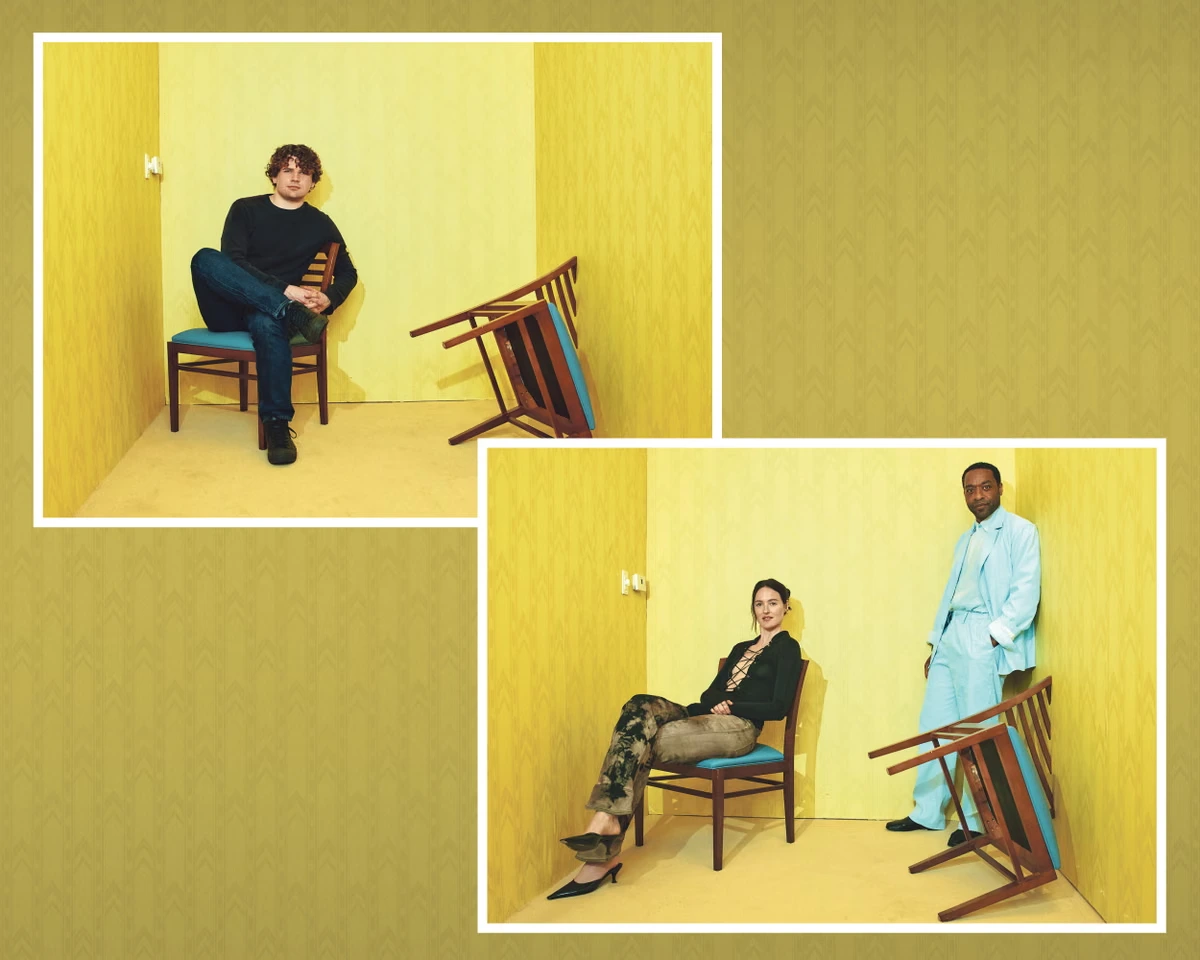
Chiwetel Ejiofor has been on a lot of movie sets, but Backrooms was something different: a 30,000 sq ft labyrinth of apparently random corridors and chambers, all carpeted, fluorescent lit and decorated in the same sickly yellow wallpaper. It was so big that people were getting lost in it, says Ejiofor: “Especially on those first days. As you try to navigate your way around and you’re like: ‘I’m sure it’s this door, I’m sure that’s the way.’” He’s laughing at the recollection. “And you find yourself just back in the wrong corner of the whole studio and you’re like: ‘Get me some help!’”
This is kind of the point of Backrooms – the movie and the online phenomenon that spawned it. It’s a concept that takes some unpacking, but as the premise for a buzzy A24 horror freakout, you could summarise it as something like “The Blair Witch Project meets Severance” or “The Shining set in an infinite Travelodge”or maybe “the exact opposite of a Wes Anderson movie”. Comparisons fall short, partly because the Backrooms concept feels as if it’s come from another world – a parallel dimension, even. Ejiofor concurs: “There was stuff that we were doing by the end of the film that I was just like: ‘This is among the most bizarre things I have ever been involved in.’”
Possibly even freakier than the Backrooms concept is the fact that its creator is just 20 years old. The Californian director, Kane Parsons, had never made a feature film before this. Like most gen Zers, he hadn’t even been to the cinema that much: “It’s something that I didn’t ever make enough time for in the past,” Parsons says, half‑apologetically, over a video chat from Los Angeles. “Growing up with YouTube, it’s like there’s a lower requirement to go out and consume through a cinema.”
Whether Parsons is the death of cinema or its future remains to be seen. In person he’s neither shy and awkward nor cocky and overconfident; more serious and focused, and very talkative – “sorry, I’m a rambler,” he says at one point. He’s no novice, either: Parsons has been making films since he was a small child, he says, and has made several hundred of them. He actually spends more time creating content than consuming it, he says. Still, walking on to that vast set, and directing seasoned crew members and actors twice his age, such as Ejiofor, Renate Reinsve and Mark Duplass, is an experience most newcomers would find pretty intimidating, if not downright terrifying.
“I recognised it as a big, potentially jarring, leap forward,” Parsons acknowledges matter-of-factly. “Like: ‘Holy shit, I am on an accelerated fast track somehow, because some shadowy overlord decided to …’ I have no idea how all of this spiralled to the place it’s at now. But I was there, and I know I wanted to make the movie, and I knew how to make what I make online. And I feel when it comes to the actual creative direction, knowing what’s wanted, that’s there.”
The origin stories of the backrooms and Parsons himself are intertwined. It began with a single photograph, taken in 2003 but posted in May 2019 on a 4chan message board inviting users to submit “disquieting images that just feel ‘off’”. This particular photo, of a vacant shop space in Oshkosh, Wisconsin – fluorescent lighting, suspended ceilings, that dingy yellow wallpaper – somehow struck a nerve and took on a life of its own in the fertile realms of “creepypasta” – viral online horror content. People began writing stories based on it, expanding this imaginary realm into a whole universe of unsettling yet mundane “liminal space”. The r/Backrooms subreddit now has over 350,000 members. One backrooms wiki catalogues reams of fan fiction, 100 different levels and an index of “entities” inhabiting them.
“I first saw that image when I was in eighth grade,” says Parsons. “I probably saved it to my computer at the time and was generally like: ‘I get an interesting feeling from this.’” At that stage, he was living in Petaluma, just north of San Francisco, still sharing a room with his brother. His parents divorced, amicably, when he was seven. He lived with, and feels equally connected to, both of them, he says. His father is a visual effects artist and his mother a therapist. “The two of those perspectives probably have shaped many, many things in many, many ways that I could not even begin to start expressing.”
His dad was not a direct influence, but he gravitated towards 3D animation “through just general osmosis”, he says. He grew up drawing, playing sandbox games such as Minecraft and watching YouTube “how-to” videos. Then, in 2020, Covid happened. “I did not have a specifically negative experience personally during the pandemic,” he says. “For me, it was mostly marked by like: ‘Whoa, no school. Amazing.’” He used the time to teach himself Blender, the free, open-source modelling software.
Parsons’ first backrooms-based short was an exercise in sustained terror in itself, extrapolating that initial creepy image into a creepy point-of-view, found-footage horror – all garish 90s video quality, humming fluorescent lights and corners you hardly dare look round (and we are not alone down there). He uploaded it to YouTube in 2022, where it rapidly gathered a “scariest video on the internet” buzz. Within two weeks, it had 20m views; it has nearly 80m today. Even this was not a novel experience for Parsons: for the previous few years, he had been posting shorts related to the beloved manga Attack on Titan, which regularly clocked up 10m views. The backrooms stuff he saw more as a “palate cleanser” initially, to test out his effects skills. But the response encouraged him to carry on.
By the time Hollywood caught up with all this in 2023, Parsons – still in high school – had made 22 more episodes of his backrooms series, steadily adding more depth and backstory (in one eight-minute instalment, a team of government researchers analyse the backrooms’ ceiling panels and lighting components in absurdly forensic detail). People still find it difficult to believe these YouTube shorts are 100% digital animation, created by a teenager with a laptop, but Parsons confirms that they really are.
Translating this lore into a feature-length movie, with fleshed-out characters played by actors, was a challenge – especially since the power of the concept largely stems from its inhuman, depopulated soullessness. Reinsve, better known for arthouse drama such as Joachim Trier’s recent Sentimental Value, was initially “scared”, she says, of working with “someone who doesn’t really have their references in movies”. “But she was also intrigued by “this new wave of building something creative”. When she met Kane she was persuaded. “I just found him so smart and eloquent”, and by the time they were shooting, she was humouring his lack of film knowledge. “One of our first conversations when I got to Vancouver was that this world kind of reminded me of [David Lynch’s] Blue Velvet. And he was like: ‘Oh, I’ve never seen that.’ I was like: ‘Really? You’re a film-maker and you’ve never seen that movie?’”
But youth and inexperience can be assets, says Ejiofor: “You can have such strong ideas and such clarity of thought when you’re young. There’s something very exciting about somebody who is incredibly knowledgable about something and has the capacity to express it in a way that isn’t convoluted, isn’t confounded by this process of growing.”
Ejiofor plays a failed architect in the film, now running a cheap furniture warehouse and even sleeping in it. Reinsve plays his therapist, who is understandably concerned when he comes to her ranting that he’s found a portal to a weird, yellow-wallpapered parallel world. She has some architecturally related emotional baggage of her own, too. They’re both headed towards a conclusion that’s gratifyingly off the rails and impossible to fully explain, even if you’ve done your YouTube homework. There’s plenty of scope to continue the story, Parsons admits: “There’s a lot more space to explore there.”
Essentially, these backrooms seem to be generated from (or possibly by) their visitors’ own psyches, becoming more abstract and surreal the further visitors go – an infinite regression of copies of copies, untethered from reality, meaning, sanity. “The more times it remembers something, the less it does,” says Clark, Ejiofor’s character.
“I think Kane is really scratching at something that is in a lot of people’s psychology,” says Ejiofor. “I would come off from certain days and think: how do I think about my memory? How do I reshape events? Do I create my own sort of backrooms, these distortions of other things? Do I operate in a slightly cyclical way with minor adjustments?”
The existential aspect appealed to Reinsve as well, “like how it circles around psychology and how you can get lost in your own patterns and how difficult it is to get free from them”.
“On an individual level, you can say this place has opened up to someone who has maybe closed themself off to every other direction and they’ve been sitting still, staring at a wall for too long,” Parsons says, but he also sees the backrooms as a reflection of a larger malaise, “a non-space propagated by an industrial monoculture”.
He describes them as “the obvious outcome of just everything we as a species have been doing for a long, long time … Everywhere is starting to look more and more the same, and we’re drowning in information. But all that information is just turning into a cloud of noise that feels very meaningless. We’re hitting a place where information about our world is getting filtered through so many systems that are inherently putting it through a blender and regurgitating it back out in a pretty distorted form.”
What he seems to be getting at is that the built environment is already a reflection of our societal madness. The banality is evil, you could say. Others have interpreted the metaphor in terms of anything from Covid isolation to artificial intelligence to a general postmodern “death of meaning”.
Ejiofor sums it up neatly: “I somehow get what it’s saying. I can’t articulate it exactly, but I feel it – and that is cinema, isn’t it?”
But not quite as we know it. The online/gaming/DIY film-making spaces Parsons has come from could be the jolt of life cinema needs, injecting new talent and stories into the industry. It doesn’t always work: 2018’s Slender Man movie tried to pull off a similar creepypasta crossover – and failed. But the YouTube pipeline has also brought in the likes of Bo Burnham (Eighth Grade), Danny and Michael Philippou (Talk To Me, Bring Her Back) and David F Sandberg (Lights Out, Annabelle: Creation).
Parsons doesn’t get hung up on format: “Who gives a shit if it’s a movie, if it’s a TV show, if it’s a video game? It’s like: ‘Here’s a story. How strongly does it make you feel and pick up on these ideas that it wants to convey?’” His generation is accustomed to consuming stories across different media. “I think that was kind of a subconscious, prevalent, just normalised thing online that I grew up with: I was more interested in the contents of the story rather than how it was conveyed.”
Even if Parsons could save cinema, he might not want to. He’s been quite happy doing stuff for YouTube on his own, after all. “It’s sort of evolved to a place where I have no timeline and no budget and no restraints other than what I can do with a single laptop and ideally as much time as I want to put into something.”
But in terms of film careers, you could hardly wish for a better start. Making a “proper” movie has given him a new appreciation for the medium, he says. “I’m still not the biggest cinephile, but I’m not under a rock and I definitely have a lot of favourites”, he says. He became especially enthused doing the sound mix for Backrooms “and realising how cool the theatrical mix is compared with the near-field mix [for broadcast or streaming]. I was suddenly like: ‘Wait a minute, I have to go into a cinema for every single thing I watch from now on.’ So yes, I deeply enjoy the cinema experience.” And he’s only 20; plenty of time to watch Blue Velvet.